European eels use an electromagnetic “sixth sense” to navigate during their long migration, two new studies propose.
The electrical “shadow” of a new moon may help eels cross the continental shelf of Europe to shore. Then, in the brackish waters of an estuary, young eels can imprint on the unique magnetic signature to navigate upstream.
Piecing together the eels’ directional cues could help fisheries managers create more effective conservation plans for this critically endangered species.
Far out in a featureless sea, the light of the moon is a beacon for migrating eels. They’re aiming for coastal estuaries, gateways to freshwater rivers where they will live for decades. When visibility becomes poor, eels can read an estuary’s unique magnetic map to navigate upstream.
New research led by Alessandro Cresci, a Ph.D. candidate in biological oceanography at the University of Miami in Florida, is highlighting two key stages in the migration of European eels (Anguilla anguilla), an IUCN Critically Endangered species.
“There’s a lot of work on how eels respond to patchy stimuli like light,” Cresci said of past research. “But we wanted to look into more stable navigational cues.”
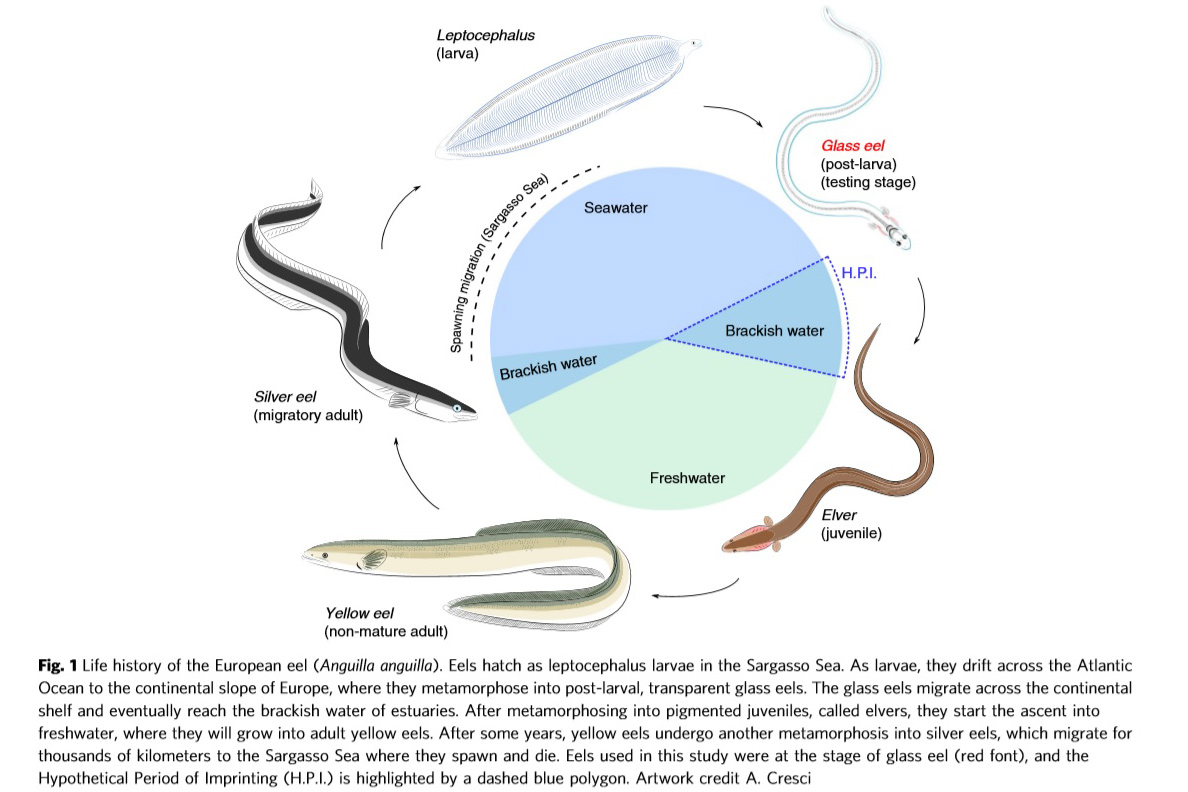
Glass eels are one phase in the complex life history of the European eel (Anguilla anguilla). Figure adapted from Cresci et al. (2019a).
The first study, published in a recent issue of Communications Biology, describes eel navigation using magnetic fields in brackish waters. The second, published in Royal Society Open Science, identifies lunar cues that guide eels at sea.
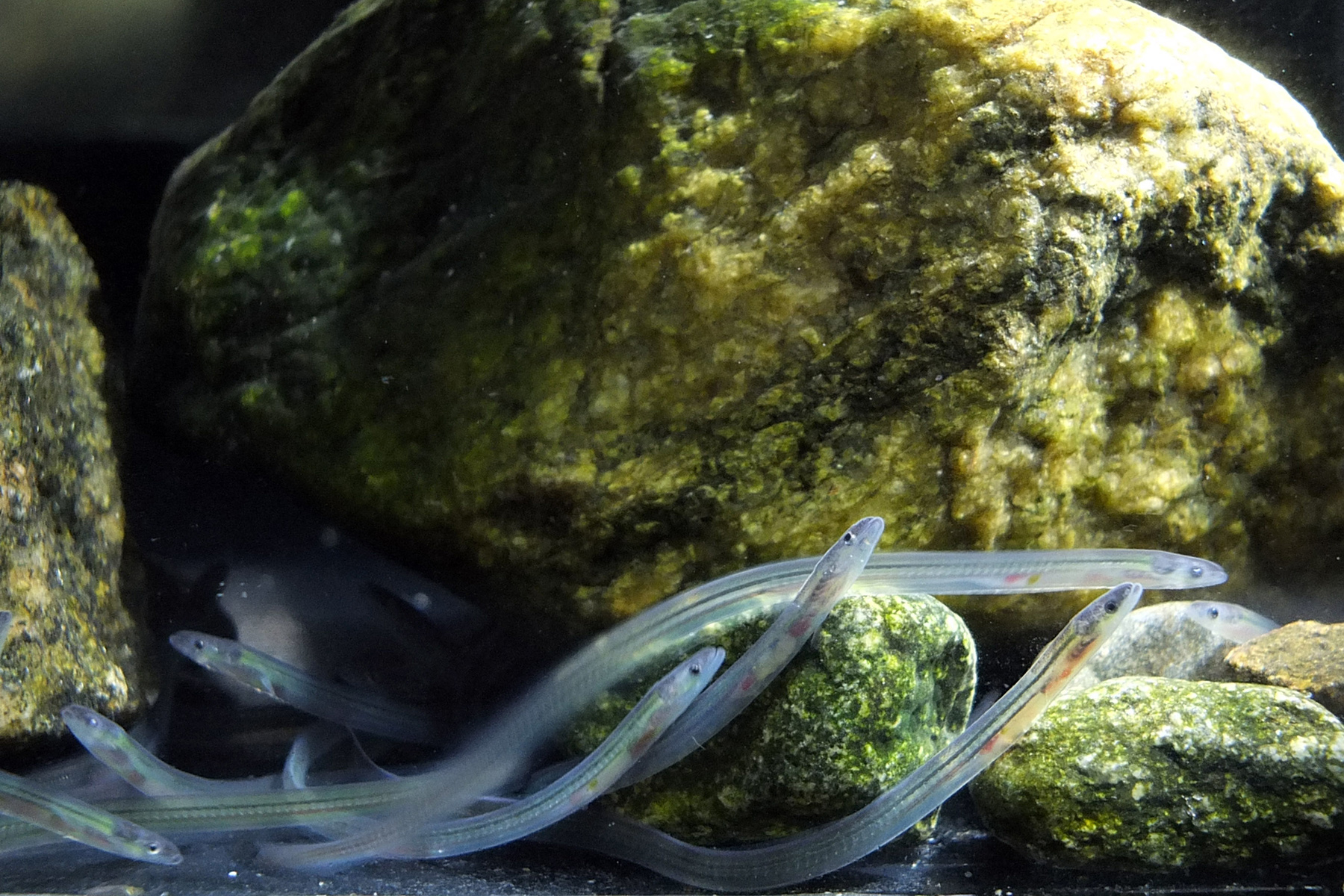
European eels begin as leaf-shaped larvae riding the Gulf Stream across the Atlantic Ocean, from the Sargasso Sea near Bermuda to the continental shelf off western Europe. Over the two-year crossing, they metamorphose into transparent glass eels just 7 centimeters (3 inches) long. Hundreds of millions arrive each year at coastlines from Scandinavia to Morocco.
Navigating up estuaries toward inland rivers, glass eels turn a camouflaging brown. They live for 5 to 30 years in the same river, growing from immature yellow adults into silver eels up to 1 meter (3 feet) long. Finally, these mature eels return to the Sargasso Sea to spawn and die. Their lifelong migratory loop tops 10,000 kilometers (6,200 miles).
Passing from open ocean into murky rivers, eels must rely on all of their senses to navigate. Scientists have shown that eels use smell, temperature and tides to find rivers close to shore, and many are thought to respond to the lunar cycle.
However, while magnetic and lunar navigation has been studied heavily in other species like salmon, according to Cresci, “the marine phase of the eel migration is really a black box.”
A single eel swims in a transparent observation chamber during an experiment. Photo courtesy of Alessandro Cresci.
To study their navigation in the open ocean, Cresci and his team collected 203 glass eels from the Austevoll Archipelago in Norway. Drifting over the continental shelf, they deployed a transparent chamber that mimicked natural conditions for the eel inside while compasses logged its preferred swimming direction. Tests were run in daylight during the four phases of the moon: new, first quarter, full and third quarter.
Most eels swam in a purposeful, non-random direction. The trend was strongest during the new moon, when 96 percent of all eels swam quickly towards the moon’s position above the horizon.
This caused the eels to generally swim southward, the average direction of the moon’s path across the sky from east to west. Glass eels are pulled northward by the powerful Gulf Stream, and while they can’t overcome this current, angling in a southern direction makes it more likely they will land somewhere favorable.
However, the new moon rises with the sun and casts very little light. Cresci and his colleagues think eels follow the moon’s electrical signal, not its faint glow.
Positioned between Earth and the sun, a new moon is exposed to solar winds that blow negative electrical charges to Earth’s surface. In effect, said Cresci, this forms a “shadow” that the eels’ sensitive receptors can detect.
It’s likely, he added, that the light of the full moon helps orient the eels as well. They are preparing to conduct the same tests at night, when the full moon rises above the horizon.
But once eels reach the muddy bends of an estuary, the moon isn’t useful. Estuaries flow with tidal rhythms, and the motion of sea water across Earth’s magnetic field creates small electric currents that are also detectable by fish.
Because European eels settle in one river, Cresci thought young eels might imprint that river’s specific electromagnetic signature to form a lifelong, rudimentary map to navigate back to the Sargasso Sea as adults.
Cresci and his team collected another 222 eels from estuaries in Norway flowing along different compass axes. In a remote facility designed to study magnetic orientation in aquatic organisms, they manipulated electric coils to randomize the magnetic field and recorded how eels oriented in the invisible magnetic current.
About 70 percent of eels oriented to the tidal conditions taking place in their home estuary at that moment. If the tide was ebbing, eels oriented one way; if the tide was flowing, they shifted their bearing by 180 degrees, a response to the change in the electric field caused by the reversal of flowing water. Glass eels remembered the tidal signature of their estuary and responded to it even when removed.
Together, these studies paint eels as multifaceted navigators.
“I think they can sense a lot, but they use specific cues at each step depending on the environment,” Cresci said.
The work is “good research by good scientists,” said Paul Coulson, Director of Operations for the UK-based Institute of Fisheries Management, who was not involved in either study.
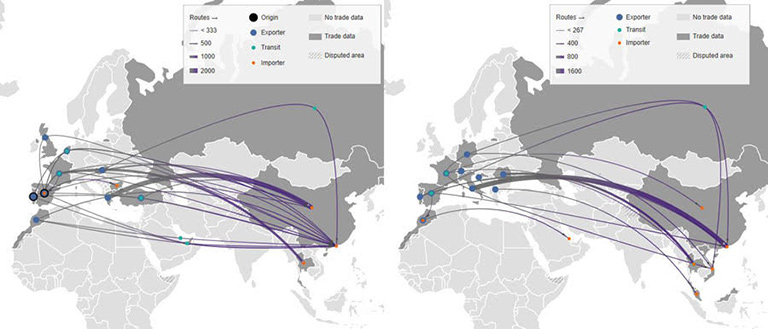
A recent report highlights a sharp increase in international smuggling of glass eels. The left figure shows kilograms of fish smuggled (visualized by thickness of the line) between 2013-2017, while the right shows only the period between 2017-2019. Graphic courtesy of TRAFFIC.
Understanding eel navigation is essential to their conservation, Coulson said. Overfishing has reduced European eels to less than 10 percent of their historical population. The European Union ended international commercial trading in 2010, but the wildlife trade monitoring group TRAFFIC recently reported a surge in glass eel smuggling. Coulson calls it “by volume, the largest wildlife crime of animals on the planet.”
The EU is also implementing a restocking program. Countries like France with large glass eel fisheries must retain 60 percent of their catch to help repopulate the eels’ historic range. Cresci’s results suggest that moving eels from their home rivers could disorient them.
“We relocate millions of animals each year, so the imprinting results are quite important,” Coulson said. “Keeping them on the same migratory track is something we should consider.”
As each link creates a fuller picture of how eels navigate a shifting environment, Cresci says he feels confident in their resilience: “Nature can be surprising, and this ancient and mysterious creature of a few inches can accomplish incredible things.”
Glass eels are a juvenile form of the European eel (Anguilla anguilla), a species that undergoes an incredible 10,000 kilometer (6,200 mile) migration. Photo courtesy of Alessandro Cresci.
CITATIONS
Cresci, A., Durif, C.M., Paris, C.B., Thompson, C., Shema, S., Skiftesvik, A.B. & Browman, H.I. (2019a) The relationship between the moon cycle and the orientation of glass eels (Anguilla anguilla) at sea. Royal Society Open Science 6(10). https://doi.org/10.1098/rsos.190812
Cresci, A., Durif, C.M., Paris, C.B., Shema, S., Thompson, C., Bjelland, R., Skiftesvik, A.B. & Browman, H.I. (2019b). Glass eels (Anguilla anguilla) imprint the magnetic direction of tidal currents from their juvenile estuaries. Nature Communications Biology 2(366). https://doi.org/10.1038/s42003-019-0619-8
Amanda Heidt (@Scatter_Cushion) is a graduate student in the Science Communication Program at the University of California, Santa Cruz. Other news stories by UCSC students can be found at https://news.mongabay.com/list/ucsc/.
Invertebrate declines are widespread in terrestrial ecosystems, and pesticide use is often cited as a causal factor. Here, we report that aquatic systems are threatened by the high toxicity and persistence of neonicotinoid insecticides. These effects cascade to higher trophic levels by altering food web structure and dynamics, affecting higher-level consumers. Using data on zooplankton, water quality, and annual fishery yields of eel and smelt, we show that neonicotinoid application to watersheds since 1993 coincided with an 83% decrease in average zooplankton biomass in spring, causing the smelt harvest to collapse from 240 to 22 tons in Lake Shinji, Shimane Prefecture, Japan. This disruption likely also occurs elsewhere, as neonicotinoids are currently the most widely used class of insecticides globally.
How the world’s most widely used insecticide led to a fishery collapse
Neonicotinoids wiped out plankton and fish in a Japanese lake, and are likely harming aquatic ecosystems worldwide, new research suggests.
In 1993, farmers in Shimane Prefecture, Japan began using
neonicotinoids in their rice paddies and agricultural fields.
Kilograms of neonicotinoids sold annually in Shimane Prefecture
May 1993
Start of neonicotinoid use
in Shimane Prefecture
Runoff containing neonicotinoids from fields and paddies was
linked to a dropoff of zooplankton biomass in Lake Shinji.
Monthly measurement of zooplankton in micrograms carbon per liter
present in water from Lake Shinji
May 1993
Start of neonicotinoid use
in Shimane Prefecture
Populations of commercial smelt and eel in Lake Shinji, which
were reliant on zooplankton and benthos as a source of food,
began to collapse.
Tons of smelt and eel, caught annually in Lake Shinji
Doping of transition metal dichalcogenides in molecularly imprinted conductive polymers for the ultrasensitive determination of 17β-estradiol in eel serum
Biosensors and Bioelectronics
journal homepage: http://ees.elsevier.com
A B S T R A C T
Molecularly imprinted polymers (MIPs) have been developed to replace antibodies for the recognition of target molecules (such as antigens), and have been integrated into electrochemical sensing approaches by polymerization onto an electrode. Electrochemical sensing is inexpensive and flexible, and has demonstrated utility in point-of-care devices. In this work, several 2D (conductive) materials were employed to improve the performance of MIP sensors. Screen-printed electrodes were coated by the electropolymerization of aniline and metanilic acid, commingled with target molecules and various 2D materials. Tungsten disulfide (WS2) with an average particle size of 2 μm was found to increase the sensitivity of detection of molecularly imprinted conductive polymer-coated electrodes to 17β-estradiol. As estradiol concentrations are important to eel aquaculture, we screened eel serum samples to determine their 17β-estradiol concentrations, which were found to be in the range 28.2 ± 3.6 to 73.0 ± 11.6 pg/mL after dilution. These results were in agreement with measurements using com-
First observation ever of a spontaneously matured female European eel
Published on
November 1, 2019
For the first time in history, scientists have observed a spontaneously matured female European eel. She was caught in 2002 and has since lived in the Finnish aquarium house Maretarium in Kotka. Researchers of Wageningen University & Research have, together with colleagues of the Natural Resources Institute Finland and the Maretarium, studied the eel to gain knowledge on the natural process of sexual maturation. The gained insights will contribute to the closing of the production cycle of eels in aquaculture. The information is also very important for conservation of the natural population.
Spawning in the Sargasso Sea
At the end of their life, European eels migrate from the European freshwaters to the Sargasso Sea to reproduce. When they leave the continent, they are 5 to 50 years old but still pre-pubers. After a 5 to 6,000 km swim trip, they reproduce and die afterwards. Two day old larvae have been caught in the Sargasso, to date still the most convincing evidence that reproduction should be occurring there. Naturally matured eels have never been caught, in the Sargasso Sea or elsewhere. In captivity only by long-term hormonal treatment eels can be matured artificially.
The live eels at the Maretarium (photo by Pauline Jehannet)
The spontaneously matured eel was a 43 year old female, stocked as a French glass eel in the Finnish Lake Vesijärvi in 1978. She was part of a batch of twelve eels that was re-caught again in 2002 and which was then transferred to the Finnish Maretarium in Kotka. Last summer this eel increased her belly size as a sign of the oocyte hydration response that occurs during the final stage of sexual maturation. Finally she died at a length of 114 cm and a weight of 3.3 kg with most oocytes having overripened but without having released any. The remaining eels will be closely monitored for progressing maturation.
Eel aquaculture and conservation of the natural population
Eels can be reproduced artificially by hormonal injections in captivity but the larvae die before they feed. “In Wageningen we can produce larvae weekly” says researcher Arjan Palstra of the Eel Reproduction Innovation Centre, a collaborative R&D initiative between Wageningen Livestock Research and the sustainable eel foundation DUPAN. “But what always has been lacking was a natural reference for the process of sexual maturation in eels. And that is important as the quality of the eggs and larvae that we produce could be improved.”
With the newly gained insights, the researchers expect to be able to improve the protocols and develop ways to naturally mature eels. And that will contribute to closing the production cycle as eels still cannot be propagated. But the information is also very important for management of the natural population and conservation of this iconic fish.
A Japanese university known for its technique to cultivate bluefin tuna has succeeded in incubating and growing for 50 days Japanese eels, an endangered species that is a sought-after delicacy in the country.
Kindai University, which sells the bluefin tuna it farms, said Friday it will also aim to achieve "full-cycle" aquaculture of eels, meaning incubating and cultivating eels and then obtaining second-generation eels from them, for commercial use.
[Courtesy of Kindai University]
In 2002, Kindai University became the first institution in the world to achieve full-cycle aquaculture of bluefin tuna. The fish has gained popularity as "Kindai tuna."
"With eels as well, we will try to achieve sustainable aquaculture, without depleting natural resources," said Shukei Masuma, head of the Aquaculture Research Institute of the university based in Higashiosaka, Osaka Prefecture.
Efforts to cultivate Japanese eels, designated in 2014 as endangered by the International Union for Conservation of Nature, have been led by the state-run Japan Fisheries Research and Education Agency, which succeeded with full-cycle farming in 2010 for the first time in the world.
Kindai University said about 30 eel larva, which were artificially incubated on Sept. 12 at its research facility in Wakayama Prefecture, have grown to about 2 centimeters over 50 days.
The university is separately growing around 1,100 larva. If things go smoothly, some of these are expected to grow to a marketable size next spring.
In a bid to cut back on aquaculture costs and workloads, Kindai will try to develop a feed that is less likely to pollute water, according to the university.






 [Courtesy of Kindai University]