Angulas are astronomically expensive, up to 1,000 euros per kilo, which is strange because they don’t taste of much at all.
B
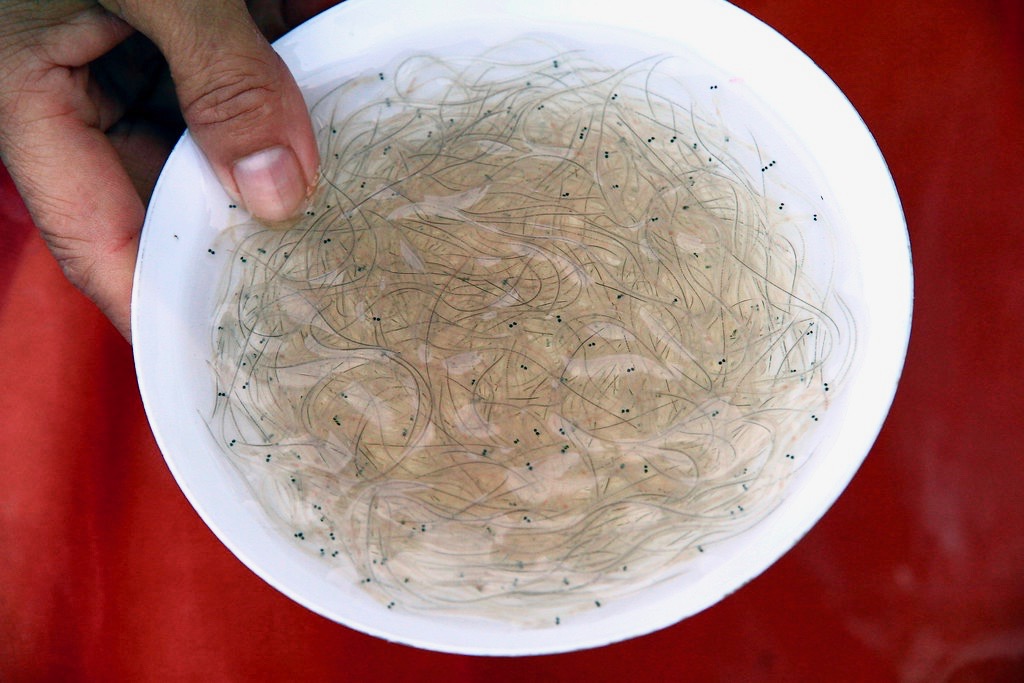
Baby eels are one of Spain’s most expensive foods, but when you see them for the first time you might wonder why.
They’re not, to put it mildly, something that cries out to be eaten. When alive, they’re transparent and slimy, slithering and squirming like tiny snakes. Cooked, they turn opaque and resemble limp, dead worms, except they’re white with two tiny black dots for eyes. Hungry yet?
They’re not something that cries out to be eaten
But lots of delicious things are not particularly good looking; what’s important is the taste. Here’s where it gets strange. It’s not that angulas, as they’re called in Spain, taste good or bad. They don’t taste of much at all – which is strange because they’re astronomically expensive, up to 1,000 euros a kilo. Even stranger still, legend has it they were once so unappreciated they were used as fodder for chickens and pigs. But then again, when it comes to eels, everything is strange.
Many Spaniards find it difficult to understand why some people are willing to pay so much for angulas, including me. As a writer and podcaster about Spanish food and culture, I’ve always found it mystifying. Especially because the traditional recipe (a la bilbaína) calls for frying garlic and hot peppers in lots of olive oil and then adding angulas – a sure way to overpower their mild flavour.
Baby eels, or angulas, are one of Spain’s most expensive foods (Credit: David Doubilet/Getty Images)
Of course, mystery surrounds eels, not least when it comes to their life cycle, which sounds like something out of a dark fairy tale. They live in freshwater, but can breathe through their skin and travel over land for long distances. They eat just about anything, living or dead. Then at the age of 10 or so, they swim downstream in rivers across Europe to the Atlantic Ocean and somehow (it’s still unknown to science) they find their way to the Sargasso Sea, some 5,000km away. At depths of more than 500m – quite a feat for a creature that lives most of its life in shallow freshwater – they spawn and die, and their hatchlings drift on the Gulf Stream currents towards Europe, a journey that takes at least two years.
When the angulas finally arrive on Spain’s Atlantic shores, fisherman with scoop nets are waiting for them. The season starts in November, and the best time to catch them is in the middle of the coldest, blackest, rainiest nights when the tide is strong and the water is rough and turbid. Of course.
It takes at least two years for eel hatchlings to drift from the Sargasso Sea to Spain’s Atlantic coast (Credit: Siqui Sanchez/Getty Images)
While angulas are incredibly pricey, the first batch to go on auction every year are more expensive still. In 2016, the first lot up for sale weighed 1.25 kilos and sold for an eye-watering 5,500 euros. Wholesale. And yet the second lot, which weighed about the same, sold for a ‘mere’ 1,070 euros.
So why the difference? Same baby eels, bought minutes apart, just one batch before the other. Even more curious is that both lots were bought by the same man.
When it comes to eels, everything is strange
I tracked down the buyer, José Gonzalo Hevia, who owned Casa Tista restaurant in Asturias, to ask him.
“It was a bit of marketing for my restaurant and also an homage to the fisherman,” said Gonzalo Hevia, now retired. He was once an angula fisherman himself. “The atmosphere at the auction is very exciting. It’s a big media event. The next day, the name of my restaurant was in every newspaper and on every TV station.”
That kind of publicity can bring in a lot of customers. “Some of my clients came back 20 or 30 times a season to eat angulas,” Gonzalo Hevia added. When I asked him what’s so special about them, he said, “It’s the texture more than anything.”
Legend has it that angulas were once so unappreciated that they were fed to chickens and pigs (Credit: Mike Randolph)
But the texture doesn’t seem so special to me. I remember them as slippery, with a very slight crunch. Still wondering why people would pay so much for them, I visited Arima, a noted Basque restaurant in Madrid, and spoke to the head chef, Rodrigo García Fonseca.
García Fonseca, who served 3kg of them in one week this past January, also a la bilbaína, said, “I wouldn’t pay that money for them. They have no taste, no colour, nothing, not even smell. A lettuce has more aroma. But I had two guys in here that ordered half a kilo of them. Five hundred euros in one shot. Some people who have money like to spend it. Who doesn’t like being a snob from time to time?”
Nagore Irazuegi, the owner of Arima, is also from the Basque Country, where angulas are ingrained in the traditional menus of Christmas Eve, New Years and the Day of San Sebastian on 20 January. “They’re way overpriced, but some people like the ostentation of it,” she said. But she is quick to add that there is more to it. “On special feast days, it’s just a tradition to eat them. And that ties a certain class of people together. It’s a cultural thing. More than anything, people want to belong.”
In 1991, Angulas Aguinaga created imitation angulas using surimi, a paste of processed fish (Credit: Mike Randolph)
Whether or not baby eels were once fed to livestock (everyone I spoke to had heard the same story, but little evidence exists), there’s no doubt they were once the food of the working class in northern Spain. But that was back when angulas were plentiful, and therefore cheap. As angulas became scarce and prices rose, a company called Angulas Aguinaga saw an opportunity. In 1991, using surimi, a paste of processed fish, they created imitation angulas, which are called simply gulas. They look almost the same, but that’s about it. Gulas are softer and taste vaguely fishy. And yet they’re so popular you can find them in just about any grocery shop in Spain.
It was a perfect storm of demand
Part of the reason angulas are so expensive is that dams and environmental degradation have taken a toll on eel numbers, and they are now listed as critically endangered. Overfishing has also played a part. In the past, live angulas were exported to China, where they were fattened and sold as mature eels, but that has been banned since 2010. Still, a lively black market persists. In 2017, Spanish police uncovered an international angula-trafficking operation that, when busted, had a stash of gold ingots, 1m euros in cash, plus 2m euros worth of live angulas headed for China.
Three-star Michelin chefs have also played a role in the price increase. Manolo González, an award-winning food writer and historian from San Sebastian and secretary of one of the city’s famed gastronomic clubs, Cofradía del Ajo y el Perejil (The Brotherhood of the Garlic and Parsley), explains. “When I was young, in the 1950s and 60s, we ate a lot of angulas. At that time, they were still considered too low class for a restaurant to serve, but in the ‘70s, the great Basque restaurants like Arzak started to cook with them, and all of a sudden, angulas were high class.”
Now they were not only scarce, they were also fashionable. It was a perfect storm of demand. Prices skyrocketed.
The traditional recipe for angulas a la bilbaína calls for tossing the eels with garlic and hot peppers fried in olive oil (Credit: Basque Country - Mark Baynes/Alamy)
And yet they remain popular. Why?
“Exclusivity has always played a role in gastronomy,” González explained. He likens it to buying wines that cost 5,000 euros a bottle, way beyond their true value, but worth it to some even if only to show status. While admitting that angulas don’t taste of much, González does enjoy the texture. “And for a food lover, on a special occasion, 80 euros for an appetizer isn’t completely out of reach.”
Exclusivity has always played a role in gastronomy
While he himself doesn’t cook with them anymore because of the high price, the taste of the classic angula recipe with oil, garlic and hot peppers still holds fond memories.
“You can make the same dish but with using spaghetti. We call it Poor Man’s Angulas,” he said with a touch of irony. “Try it, you’ll see how delicious it is!”
Join more than three million BBC Travel fans by liking us on Facebook, or follow us on Twitter and Instagram.
If you liked this story, sign up for the weekly bbc.com features newsletter called "If You Only Read 6 Things This Week". A handpicked selection of stories from BBC Future, Earth, Culture, Capital and Travel, delivered to your inbox every Friday.
Intricate color patterns are a defining aspect of morphological diversity in the Felidae. We applied morphological and single-cell gene expression analysis to fetal skin of domestic cats to identify when, where, and how, during fetal development, felid color patterns are established. Early in development, we identify stripe-like alterations in epidermal thickness preceded by a gene expression pre-pattern. The secreted Wnt inhibitor encoded by Dickkopf 4 plays a central role in this process, and is mutated in cats with the Ticked pattern type. Our results bring molecular understanding to how the leopard got its spots, suggest that similar mechanisms underlie periodic color pattern and periodic hair follicle spacing, and identify targets for diverse pattern variation in other mammals.
An entry in a Pilgrim diary recorded one day after the English, who had barely survived the brutal winter of their arrival, and the Wampanoags agreed to a peace treaty, suggests that a fat, succulent eel has as much of a claim to the Thanksgiving holiday dinner table as a turkey.
Dated Friday, March 23, 1621, the entry appears in the Pilgrim journal known as Mourt’sRelation. It describes how Tisquantum, better known as Squanto, who spoke English and acted as a mediator and translator between the English and Wampanoags, supplied the hungry Pilgrims with a delectable meal. “Tisquantum went at noon to fish for Eels, at night he came home with as many as he could well lift in one hand, which our people were glad of, they were fat & sweet, he trod them out with his feet, and so caught them with his hands, without any other Instrument.”
For thousands of years, the American eel, one of the most enduring mysteries in natural science, was part of the natural bounty that Native Americans in coastal communities and later the English relied on to survive often harsh living conditions. Martha’s Vineyard’s first inhabitants, the Wampanoags, trapped eels in handmade baskets and considered them an excellent food source. Quansoo, now the name of a private beach on the Chilmark side of Tisbury Great Pond, is Algonquin for “place where the long fish is caught.”
Early English residents harvested eels found in the Island’s brooks, ponds, and bays. They trapped them in the warmer months, and in winter used specially designed spears that they thrust through holes they made in the ice to catch dormant eels when fresh fish was hard to come by.
Donald Mitchell and Frank Drake spear eels on Sengekontacket Pond, circa 1960.
MARTHA’S VINEYARD MUSEUM
In a diary entry dated February 14, 1822, Jeremiah Pease of Edgartown provides evidence of their abundance in the winter months. He wrote that he and Allen Coffin, also of Edgartown, “Went eeling. Caught 52 dozen.”
Their hands full of 624 slimy fish, it is unlikely that Pease and Coffin paused to consider the mystery of the eel’s life cycle. The fish were plentiful and easily caught – until they were not.
The American eel (Anguilla rostrata) and its closely linked cousin, the European eel (Anguilla anguilla), are catadromous, meaning Atlantic eels spend most of their lives in freshwater or brackish tidal environments. They only return to the ocean to spawn and then die.
For thousands of years, the origin of the eel and how and where it reproduces bedeviled a long list of thinkers and scientists. The Greek philosopher Aristotle thought eels sprang from the mud of river bottoms. And before he worked to unravel the mysteries of the human mind, in 1876, a nineteen-year-old German scientist named Sigmund Freud spent months in a small room in the Italian city of Trieste dissecting eels looking for reproductive organs, to no immediate scientific avail.
It took Johannes Schmidt, a determined Danish biologist, to answer the question of where eels breed. From 1904 to 1922 or 1923, with a break for World War I when German U-boats made his study hazardous, Schmidt seined the ocean for floating eel larvae.
Working his way back from the largest to the smallest size larva he found, Schmidt tracked the source of the eels to the Sargasso Sea, a large portion of the western Atlantic Ocean east of the Bahamas and south of Bermuda.
Swedish journalist Patrik Svensson in The Book of Eels (Ecco, 2021) said having answered that question, Schmidt could still not explain how the masses of larvae in the western Atlantic sort themselves out, “so that those individuals which belong to Anguilla anguilla ultimately find themselves in Europe, while those of Anguilla rostrate land on the shores of America and the West Indies.”
Svensson wrote, “We think we know that all eels are hatched in the Sargasso Sea, since that’s where the smallest examples of the larvae have been found, but no one knows for certain why the eel insists on reproducing there and only there. No one knows for certain how it withstands the rigors of its long return journey, or how it navigates. It’s thought all eels die shortly after breeding since no living eels have ever been found after breeding season, but then again, no mature eel, living or dead, has ever been observed at their supposed breeding ground. Put another way, no human has ever seen an eel in the Sargasso Sea. Nor can anyone fully comprehend the purpose of the eel’s many metamorphoses. No one knows how long eels can live for.” It is all part of what zoologists call “the eel question.”
The Good Years
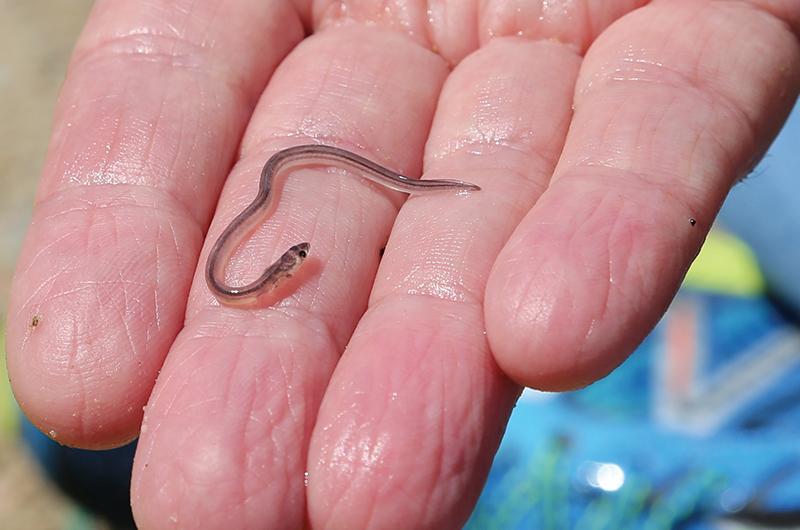
Eels begin life as an egg with the odds of survival decidedly stacked against them. They hatch into willow leaf–shaped larvae (leptocephalus). Through a combination of natural forces, likely including currents and propulsion, the larvae slowly make their way to coastal waters in Europe and North America. There, those that survive their ocean journey transform into small, translucent glass eels several inches in length, also known as elvers.
In the spring, elvers migrate from the sea and enter brooks, streams, and ponds to feed and grow. Adult eels, known as yellow eels for their slight yellowish tint, may remain in their home waterbody for ten to twenty-five years before they reach maturity and respond to a natural signal that it is time to breed.
Mature “silver” eels, called neshaw by the Wampanoags, undergo a physical transformation in preparation for their return ocean migration. Their eyes and pectoral fins enlarge, and they become black on the top and silver on the bottom.
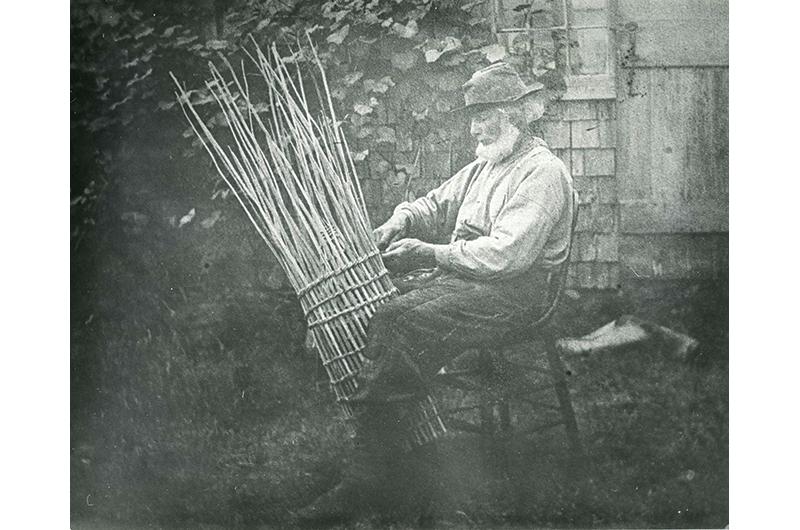
Josiah Cleveland of West Tisbury weaves a traditional eel pot from flexible wooden slats bound with lacing from split pine roots, circa 1900.
MARTHA’S VINEYARD MUSEUM
In the 1800s, Island fishermen used baited eel pots, bottle-shaped containers with a funnel mouth and closed at one end, to harvest eels. The traps were laboriously constructed entirely of wood slats bound by lacing made from split pine roots. In later years, these were replaced with traps constructed of wire mesh.
In “The Eel Fishery of Martha’s Vineyard,” published in February 1995 in the Dukes County Intelligencer, Edgartown native Clyde L. MacKenzie Jr., a longtime federal fishery research biologist, described the scope of the fishing activity in the last century.
“The major potting areas were Tisbury and Edgartown Great Ponds. In Tisbury Great Pond, Eric Cottle and Ben Mayhew worked together and set out 50 pots, using a small outboard boat. They set their pots on the Chilmark side of the pond, while Norman Benson and his son, Franklin, set 36 pots on the West Tisbury side. Franklin also set pots in the Lagoon and James Pond.”
Manuel Ferreira and Winthrop “Sonny” Norton set fifty to seventy-five pots in Edgartown Great Pond. “Manuel, along with Joe and Gene Benefit, also set pots in Sengekontacket Pond, while ‘Wid’ Norton and others set theirs in the harbor off North Water Street as well as in Katama Bay, and in Eel, Little Eel and Caleb’s Ponds.”
Because silver eels do not eat, but live off their fat reserves on their return journey to the Sargasso Sea, fishermen devised a method to intercept the eels in the great ponds as they sought an exit to the sea. Beach pots were staked down in a trench just off the shoreline along the eel’s perceived route. Wings at the pot entrance helped direct the eels into the pot.
Mackenzie said that when the ponds were closed, the “neshaws swam back and forth in a frenzy along the barrier beaches, seeking an opening to the sea…occasionally during a southerly storm that washed the ocean over the beach, they were able to slither across the wet sand into open water.”
The fishermen stored their captured eels in submerged bins known as “keeper cars” before they transported them to the market. Because eels did not survive if confined for any length of time in warm water, commercial trap fishing occurred primarily in September and October.
In the early 1900s, eels were packed in ice and shipped off in barrels and boxes. Later, mainland buyers sent tank trucks to the Island to pick up the catch. MacKenzie said that each Vineyard crew “could sell as many as 5,000 to 7,000 pounds of eels in the good years.”
By the time eel larvae leave the open ocean, they have transformed into elvers – translucent glass eels only several inches in length.
COURTESY SUE WIEBER NOURSE AND DON LEWIS
Fishing for eels was part of a natural cycle for Islanders who were reliant on the sea for a livelihood. It was hard work, but it could be profitable.
In the 1930s, Edwin Athearn, encouraged by Norman Benson, who sold him some pots, eeled in Lagoon Pond off Oklahoma Avenue in Vineyard Haven. Athearn told MacKenzie that just after Labor Day, he set out twelve pots. Early the next morning, he went out to tend them. “He couldn’t believe it,” MacKenzie said. “Hauling each pot was like lifting a bag of cement. Each pot was completely filled with eels.”
Just before Christmas, a dealer from East Boston arrived in a tank truck to Martha’s Vineyard. Athearn recalled that he was paid more than $1,000. “A lot of money in the depression,” Athearn said. “It was probably the most profitable fishing I ever did.”
Once the ponds and bays froze, and the eels sought refuge in the eelgrass and mud where they lay dormant over the winter, the only way to catch them was to spear them through holes in the ice. This required stamina, skill, and luck.
A report in a 1909 issue of the Vineyard Gazette described the pluck of Thomas Smith, “of the Head of the Pond,” who, after spearing eels through the ice, lifted his back basket full of eels and started for shore.
“Now the ice near the shore was rotten, because of the many springs, and Mr. Smith, back basket and all, suddenly disappeared from view. Others who were out saw the catastrophe and put for the shore, but were compelled to go roundabout, because of the mush ice.”
“By the time they reached the shore, the old gentleman was discovered marching along for dry land, with the basket still on his back, and someone hailed him that he had come pretty near getting drowned.”
“‘Well,’ says he, ‘I thought if I could hold my course I could sholen [sic] my water,’ and out he walked as though it were an everyday occurrence.”
Eeling activity on Martha’s Vineyard began to wane after World War II as members of the generation that pursued eels and fishing as a way of life slowly began to disappear from the Vineyard landscape. Speaking of the lifestyle that existed before the war, in 1967 Lawrence Jeffers of Edgartown told a Gazette columnist, “I fished for clams and quahaugs and scallops and eels. I remember when seventy or eighty or ninety boats would be out at once quahauging in Katama Bay. About all there was to do in those times was eeling and clamming.”
Got to Be Versatile
Chris Murphy of Chilmark was one of the last Island men to eel commercially. He got his start as a boy catching the eels his parents disturbed while digging for steamers in Tisbury Great Pond.
“I sold them to John Pachico – everyone called him ‘Long John’ – at John’s Fish Market in Vineyard Haven,” Murphy said. “That was my first cash crop. He got me to skin the eels so he could sell the eel meat, and deliver the heads with the skin attached so he could sell it for bass bait.”
Longtime Island fishermen provided guidance. “What I got from all the old guys that were [helpful] to me, Norman Benson, Dan Manter, and others, was that you’ve got to be versatile,” he said.
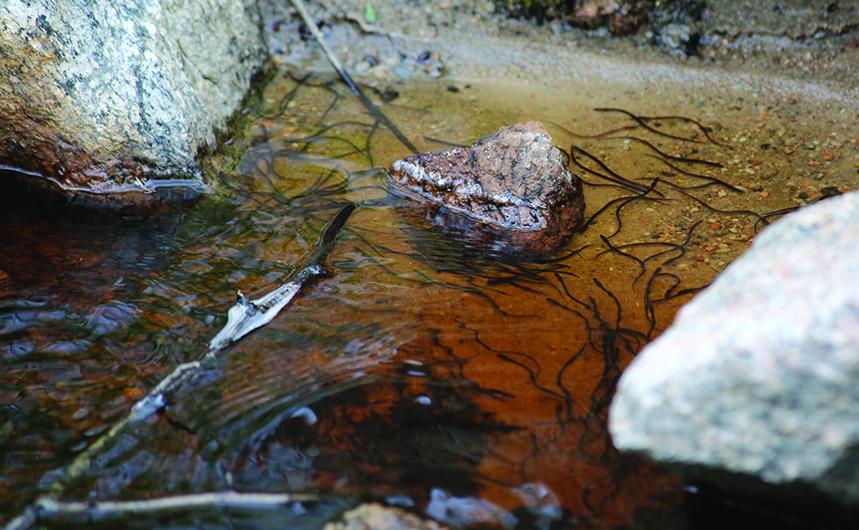
Come springtime, elvers migrate from the open ocean into coastal ponds, rivers, and streams. They are often stopped by obstacles, such as the Mill Brook dam in West Tisbury.
COURTESY SUE WIEBER NOURSE AND DON LEWIS
Married and with children, Murphy began seriously trapping eels in the sixties to augment his other fishing activities. “I did it for many years as a seasonal piece of my world,” he said.
He’d set his pots right after the first storm in September, when conditions were right for potting and holding eels.
“It was my favorite fishery,” Murphy said. “It was low impact. I was doing it with a three-horse outboard. I’d keep a boat in two or three different ponds and just carry the outboard from one pond to the next. I’d start out at daylight in the morning and probably by the end of the day haul about two hundred pots.”
The eels were transported to the mainland by tanker truck a few weeks before Christmas and then shipped to European markets where eel was a traditional holiday dish.
After twenty-five years, in the late nineties, Murphy stopped fishing for eels because there were few eels to catch.
“What happened to the eels, that’s a big question,” Murphy said.
Cooper Gilkes of Edgartown, another of the last men to commercially trap eels, learned how to make wire traps from the Island dean of eeling.
“Norman Benson showed me how to make them and I came home and made ’em up….To really make it go you had to run a lot of traps. It was all seat of the pants. No GPS. None of that stuff. Pea soup fog, you were out there, two hundred pots…oh, my God, I used to come home and my head would be splitting.
”It was the heyday of big stripers and Gilkes began selling eels to tackle shops for bait. Soon he was selling eels out of a corner of his house, which later grew to become Coop’s Bait & Tackle, the popular shop that bears his name.
Fishing, clamming, scalloping, and eeling – fishermen were linked to the season.
“In those days, you were a waterman. You worked on the water. You scalloped, you quahauged, you eeled, fluked, scup, sea bass; that was when the waterman was a true waterman, not your doctors and lawyers and carpenters buying a commercial license.”
Asked why he stopped, he said flatly: “No eels.”
We Are Losing It
American eel populations across their traditional habitats have plummeted. How bad is it? The Atlantic State Marine Fisheries Commission (ASMFC) doesn’t really know.
According to the ASMFC, “From a biological perspective, much is still unknown about the species. Information is limited about their abundance, status at all life stages, and habitat requirements....The stock is at or near historically low levels due to a combination of historical overfishing, habitat loss, food web alterations, predation, turbine mortality, environmental changes, toxins and contaminants, and disease.”
Swedish journalist Svensson has a more dire take on the European eel: “According to most research reports, the situation today is more or less catastrophic. The eel is dying, and not just in the expected way, as the natural end to a long life full of changes. It’s becoming extinct. We are losing it.”
Eels cannot be bred successfully in captivity. As a result, Asian aquaculture farms depend on a supply of elvers to produce their adult stock for the commercial market.
Overfishing to satisfy the Asian demand is one significant factor in the depletion of Atlantic eel stocks. Having overfished the Pacific population of Japanese eels and no longer able to meet home demand, Asian buyers turned to Europe, where they cleaned out the fishery of adult eels and elvers. Export is now tightly regulated but fuels a lucrative black market.
They then turned to the U.S.
Brad Chase, a Division of Marine Fisheries (DMF) senior marine fisheries biologist and diadromous fish project leader, said in response to demand from Japan in the mid-seventies, there was a big commercial push to harvest eels. The price for yellow eels went from fifty cents a pound to $2. One pound of elvers could fetch more than $2,000.
Only South Carolina and Maine now allow the sale of elvers. The fishery is tightly controlled, but poaching is a constant threat.
“We had some large catches in the mid- and late seventies, into the early eighties, and then the catches just crashed,” Chase said.
“And we haven’t recovered from that, even though we now have a lot more conservation measures in place for eels and there are a lot fewer people trying to catch them.”
Chase said, “I’ve been involved with a stock assessment, and the assessment wasn’t able to identify why we’re at historically low levels, not just in Massachusetts, but along the East Coast.”
Asked what Islanders could do to help eels, he said, “Isolate a few locations on the Vineyard where you might be able to increase their passage to nursery habitats.”Chase added, “One thing I’ve learned is that dam removals are really good for American eels. Eels do not do great going against velocities. Even low dams require them to use energy and aggregate where they’re vulnerable to predation.” In the past fifteen years, DMF has been installing “eel ramps” that act like fish ladders and have provided passage for eels where dams block access, he said.
Today, the average American is most likely to encounter eel in a tackle shop, where it is sold live and is prime bait for striped bass, or at a sushi bar where unagi – a slice of grilled eel on rice – is sold for top dollar.
DMF regulations currently allow recreational fishermen to take twenty-five eels per day that are a minimum of nine inches in length. Commercial fishermen have no harvest limit, but there is a state quota set by the ASMFC.
Chase said many fishermen trap eels to use for striped bass bait. “In just one or two human generations we’ve gotten away from using them as food,” he said.
Sara Rademaker, an enterprising woman in Maine, wants to put locally raised eel back on American dinner plates. Rademaker is the founder of American Unagi, the only land-based eel aquaculture farm in the United States. Currently, most of Maine’s glass eels are exported to Asia to be grown and then imported back to the U.S. But American Unagi has a license to harvest hundreds of pounds of glass eels annually. The company raises eels in tanks to marketable size. In addition to selling live eels to high-end chefs in nearby cities, the company sells live, smoked, and frozen eels online.
A new generation of Islanders is turning to the sea to farm oysters, kelp, quahaugs, even bay scallops. Might eels be next?
Chase said he’s met the owners of American Unagi and would like to see them be successful. Their example may point the way for Massachusetts aquaculturists as well, he said.
“It would be good to see a little more appreciation for eel as food than just for bait. It might help the push for sustainable management and restoration efforts,” he said. “Smoked eel can be fantastic.”



.jpg)
.jpg)
.jpg)
-1.jpg)
.jpg)
.jpg)
.jpg)
.jpg)
.jpg)
.jpg)


 1 comment