
Bonne nuit
2021年12月23日
<iframe width="560" height="315" src="https://www.youtube.com/embed/FMCiaLfQRU8?start=6" title="YouTube video player" frameborder="0" allow="accelerometer; autoplay; clipboard-write; encrypted-media; gyroscope; picture-in-picture; web-share" allowfullscreen></iframe>
https://www.youtube.com/watch?v=FMCiaLfQRU8
捕鰻人(上集) 大量的日本火山浮石抵達台灣宜蘭-壯圍海岸!!今年還能抓到鰻苗嗎??竟然釣到會叫的魚。【小龍觀察家】
2021年12月17日
https://www.youtube.com/watch?v=TH3T2X8DEq4
<iframe width="560" height="315" src="https://www.youtube.com/embed/TH3T2X8DEq4" title="YouTube video player" frameborder="0" allow="accelerometer; autoplay; clipboard-write; encrypted-media; gyroscope; picture-in-picture; web-share" allowfullscreen></iframe>

冷たい北風が吹き付けていた。真っ暗な海に腰までつかった防水服姿で頭にライトを付けた男性たちが、大きな網でニホンウナギの稚魚「シラスウナギ」を追う。
海から仮設テントに戻った一人が網を机にひっくり返した。小枝や海藻の小山を慎重にほぐしたが、獲物はなし。「昨季の9割減だ」。見守っていた東港村長の周永和(しゅう・えいわ)(58)がうめいた。
東港村のある台湾北東部・宜蘭県は台湾最大のシラスウナギの漁場だ。11月から翌年2月末の漁期には地元民に加え、各地から「一獲千金」を狙うにわか漁師たちが押し寄せる。

人々は繰り返し海中で網を引く。日没後に始まった漁は未明まで繰り返し続けられた。
▽開発が原因
「子どもの頃はアヒルの餌にするほど捕れた」。周が懐かしそうに話す。父親はシラスウナギ漁だけで土地と家を買った。村で家族と暮らす周は漁をしていない。村民の主な収入源は農業や出稼ぎに取って代わり、漁は「春節(旧正月)のボーナス」との位置付けだ。
漁業関係者によると、2021年11月から今年3月の漁獲量は約1・6トン。20年11月から21年2月までの間に5・7トンを捕った昨季と比べ、漁期が3月まで臨時延長されたものの大幅減となった。日中韓の分を合わせた総量も昨季比で約6割減だった。
「黒潮の位置がずれたためか」。ベテラン漁師はつぶやく。専門家は「海洋の全ての指数が悪化している。何が原因なのか分からない」と首をかしげた。
深刻なのは絶対数の減少だ。「30年間で驚異的に減っている」。国立台湾大の漁業科学研究所所長の韓玉山(かん・ぎょくさん)(51)は、ウナギがすみかとする河川や河口の開発が進み、生息域が激減したことが最も大きな原因だとみている。
台湾は13年にシラスウナギの漁期を4カ月間に制限した。だが、韓は「2カ月間に短縮すべきだ」と訴える。絶対数の減少に歯止めがかからない中、せめて漁獲規制を厳しくして減少ペースにブレーキをかけたいとの思いからだ。
▽「鰻金」
07年にはシラスウナギの輸出を禁止した。だが、香港を経由して日本に運ばれてくる実態に変わりはない。「輸出」から「密輸」に手法が変化しただけだ。
ニホンウナギは台湾のほか、日中韓などの東アジア一帯に生息する。河川で成長して海に下り、グアム島近辺で産卵。ふ化した稚魚が東アジアの海岸を南から上ってくる。台湾は「最初の漁場」に当たり、漁期は日本より約2カ月早い。
「11~12月の漁獲の9割以上が日本向けだ」と韓は言う。日本のウナギ消費のピークは7月の「土用丑(うし)の日」。6カ月かけて成魚に育てるため、日本の業者は「初物」の台湾産の確保に全力を挙げる。価格は跳ね上がり、最高値で1匹180台湾元(約740円)。密輸業者のうまみは大きい。台湾で「鰻金」とも称されるゆえんだ。
台湾政府は11年に取り締まり部門を立ち上げたが、摘発数は22年1月時点でわずか7件。「銃器や違法薬物と異なり、シラスウナギの密輸はインパクトが小さい。摘発しても評価も低いので、食指が動かない」。関係者は黙認している実情を明かした。
▽輸出ゼロ
大きないけすから金属製のレーンをつたって成魚のウナギが流れ込む。職人たちが1匹ずつ手づかみにし、50グラムごとに区切った水槽に次々と投げ入れていた。
北部・桃園国際空港近くにある輸出業者の選別場。中西部・彰化県の養殖場から夕方届けられた約5トンが、選別後に氷水で眠らされて袋詰めされ、翌朝には日本向けの航空機で飛び立つ。

「養殖期間が長すぎた。色が悪い」。旺生企業有限公司会長の郭瓊英(かく・けいえい)(68)は顔をしかめた。
新型コロナウイルス禍で日本のウナギ需要が激減した。成魚の9割を日本に輸出してきた台湾のウナギ業界を直撃し、郭は「20年4月の輸出はゼロ。46年間この仕事をしてきて初めてだ」と嘆く。
さらに東京五輪の延期と無観客開催が追い打ちを掛けた。
台湾の養殖期間は1年3カ月。五輪に伴う需要増を見込んで養殖量を増やしていたが、輸出は滞り養殖場でだぶついた。いけすのウナギは2年もので、質は大きく落ちていた。
20年の輸出量は19年から30%減った。21年は多少持ち直したが、航空便の減少により輸送費が高止まり。コロナ禍の影響は今も重い。
郭は大規模な養殖を展開している中国をライバルと位置付ける。「台湾は肥育促進剤など一切使っていない。安心安全が台湾産の強みだ」。
郭は若い養殖業者らの指導に力を入れる。技術を高めて、より質の高いウナギを生産していく。コロナ禍の苦境克服へ、地道に努力を重ねる決意だ。(敬称略、文・松岡誠、写真・徐嘉駒)
◎取材後記「記者ノートから」
国際自然保護連合(IUCN)はニホンウナギを3段階ある絶滅危惧ランクの2番目、非常に高い絶滅リスクにある「危機」と位置づけている。日本で食べられるウナギのほぼ全ては、捕獲したシラスウナギを養殖池で育てたものだ。人工繁殖技術が商業化されていないため、全て天然資源に依存している。
台湾でのシラスウナギ漁獲量は、2020年11月から21年2月までのシーズンで5・7トンだったが、台湾の養殖業者に渡ったのは4トン。残りの1・7トンは密輸に回されたとみられ、実際はさらに多い可能性もある。
成魚ウナギの輸出業者は「日本は世界中のウナギの7割を消費している」と指摘する。シラスウナギの減少と密輸の問題を突き詰めると、日本人の「食べ過ぎ」に行き着く。(敬称略)
筆者は共同通信台北支局長、写真は共同通信契約カメラマン、年齢は2022年10月1日現在
Nature 415, 859 (2002)
This kitten's coat-coloration pattern is not a carbon copy of its genome donor's.
Sheep, mice, cattle, goats and pigs have all been cloned by transfer of a donor cell nucleus into an enucleated ovum1,2,3,4,5, and now we add the successful cloning of a cat (Felis domesticus) to this list. However, this cloning technology may not be readily extendable to other mammalian species if our understanding of their reproductive processes is limited or if there are species-specific obstacles.
As a first attempt, we isolated adult fibroblast cells from oral mucosa obtained from an adult male cat, passaged them three to seven times for expansion in culture, and then froze and stored them in liquid nitrogen. For nuclear transfer, we thawed these cells and fused them with cat ova that had matured in vitro and which had had their metaphase chromosomes removed by micromanipulation (see supplementary information). We then transferred cloned embryos into synchronized recipient queens for development.
We carried out 188 such nuclear-transfer procedures, which resulted in 82 cloned embryos that were transferred into seven recipient females. One queen became pregnant with a single conceptus, which ceased to develop and was surgically removed after about 44 days of gestation. Subsequent DNA analysis confirmed that the fetus was derived from a cloned embryo.
Our second attempt involved using nuclei from another cell type for transfer, which we obtained by primary culture of cumulus cells collected from an adult female cat. In a single experiment, three cloned embryos derived from cumulus cells and two cloned embryos derived from fibroblast cells were transferred into a recipient queen. Pregnancy was confirmed by ultrasonography after 22 days of gestation and a kitten was delivered by caesarian section on 22 December 2001, 66 days after the embryo was transferred. The kitten was vigorous at birth and appears to be completely normal.
The kitten's coat colour suggested that it was derived from a cumulus cell from the female donor (Fig. 1); we therefore analysed DNA of the cumulus cells used for nuclear transfer, as well as from leukocytes in blood samples from the donor cat and surrogate mother, and from cheek cells collected in an oral swab from the kitten. We also analysed control feline samples for comparison with a random-bred cat genetic database. Analysis of seven unlinked, highly polymorphic, feline-specific microsatellite loci confirmed that the kitten is a clone (Table 1).

a, Adult female cat that supplied cumulus cells for nuclear transplantation. The cells were cultured in DMEM/F12 medium for 5 days at 37 °C until confluent; micromanipulation was used to enucleate ova obtained after routine ovariohysterectomy and to transfer the donor's cumulus cells into the perivitelline space. Enucleated ova and cumulus cells were fused by electrofusion; a second electropulse was applied to activate the oocytes. b, The surrogate mother, a synchronized recipient of three cloned embryos, produced one cloned kitten, which was delivered by caesarian section 66 days after embryonic transfer. For further details, see supplementary information.
As with other genetically identical animals with multicoloured coats, the cloned kitten's colour patterning is not exactly the same as that of the nuclear donor — this is because the pattern of pigmentation in multicoloured animals is the result not only of genetic factors but also of developmental factors that are not controlled by genotype.
At this point, we can only roughly evaluate the efficiency of cloning cats by nuclear transfer: 87 cloned embryos were transferred into eight recipients, resulting in one failed pregnancy and one live clone. This is comparable to the success rates obtained for other cloned species. On the other hand, the cloned kitten was born after the transfer of only three embryos derived from cumulus cells. It remains to be investigated whether this cloning efficiency is reproducible in cats.
在一年一度的「土用丑日」來臨前,東京海關成田海關分署,19日在成田機場貨運設施公佈進口台灣產鰻魚的通關流程。工作人員撿起活鰻並檢查是否有異物。據了解因為新型冠狀病毒的影響,過去鰻魚銷量下降,但是需求量至今已恢復到疫情前的水準。
位於千葉縣成田市的專業貿易公司「丸勝」,當天從台灣和中國進口了約2.1噸鰻魚。據稱批發價為每公斤4000日圓左右,與去年相同。
根據東京海關統計,成田機場的活鰻魚進口量佔全國總量的90%。
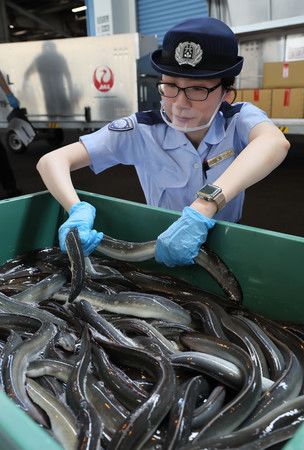
確認進口鰻魚的海關職員=19日下午、千葉・成田機場


