Sunday, August 16, 2020

The Eel Story

The Eel Story


https://vimeo.com/345454538

<iframe src="https://player.vimeo.com/video/345454538" width="640" height="360" frameborder="0" allow="autoplay; fullscreen" allowfullscreen></iframe>

<p><a href="https://vimeo.com/345454538">The Eel Story</a> from <a href="https://vimeo.com/user65694822">Sustainable Eel Group (SEG)</a> on <a href="https://vimeo.com">Vimeo</a>.</p>

Thursday, August 06, 2020

什麼叫種鰻?!

故事...

催熟前,在肚子開一小刀,兼拿卵巢與肝臟組織 (順便判別公母),當然還它們還要捐點血。
十週後,有的魚肚子大起來 (只打了一針雄性素和兩針催熟液),傷口的縫線還在!後面那一個縫線是取肌肉組織留下的。

好了,我們可以用轉錄組的比較來說明:“什麼叫種鰻” ...


 成鰻並無獨立的脂肪組織,而是和肌肉組織交雜在一起,本年度已獲得的肌肉轉錄組的初步結果,根據初步的分析結果顯示: 在起始階段,肌肉組織中adiponectin (脂聯素)的表現量比leptin (瘦體素)的表現量和後來卵巢催熟結果較據相關性,同時,肌肉組織中,除粒線體的活性與完整性,與其脂肪脢(lipases)的表現量,肌肉組織脂肪合成脢表現量(例如DGATla,DGATlb,ACACa,ACACb與 FASN),同時脂肪酸延長脢 (fatty acid elongas,elovl1a、elovl1b、elovl2、elovl4a、elovl4b、elovl5、elovl6、elovl6l、elovl7a、elovl8a、elovl8b) 基礎表現量,似乎和後來卵巢催熟結果有正相關,而且數量極差異極高 (> 4倍)。

肝臟脂肪合成脢表現量(例如 DGAT2 與 DGATla,ACACb與 FASN),似乎和後來卵巢催熟結果有顯著的關係,但同時脂肪酸延長脢表現量相關性卻變異較大,肝臟中卵黃前質這顯示能量和生殖的重要關聯,但彼此如何溝通,尚待下年度的實驗與調查。另外,轉錄組數據顯示肝臟和肌肉組織 (肌肉加脂肪)是合成脂肪與分解脂肪的重要器官,但肌肉中相關基因的表現量較能代表後來的催熟成效。

肌肉與肝臟轉錄體結果顯示: 肝臟中若起始的可體素受體(nr3c2)表現量和後來的催熟成果成負相關,表現量較低者催熟成功機率大,有趣的是可體素受體的異構物(nr3c1)的起始表現量則剛好相反! 表現量較高者催熟成功機率大。在肌肉中,nr3c1的起始表現量較高者催熟成功機率大,而nr3c2的起始表現量則和催熟成果關聯性較小。值得一提的是,轉錄組中,缺乏FGF21的資料,轉錄組中有 FGF1a,b、2、3、4、5、6a,b、7、8a,b、9、10a,b、11a,b、12a,b、13a,b、14、16、17、18a,b、19、20a,b、22、23、24,在肝臟中,FGFs的基礎表現量,雖有變異,和後來的催熟結果大約呈ㄧ正相關,而肌肉中也有類似的現象但變異更大,這結果暗示肝臟中的FGFs影響催熟的過程;我們好奇那麼肝臟的卵黃原質(vitellogenein)的起始表現量和後來的催熟成果有何關聯? 結果呈現: 卵黃原質 (Vgt1、2、3、4、5、6、7)的起始表現量和後來的催熟成果成負相關,推測此時 (卵細胞直徑不大於170 um),卵細胞主要是處於內生性卵黃期,此時肝臟產生的卵黃前質並無法被卵細胞利用(此時循環中的FSH和LH或卵巢的相關受體並未被偵測到),肝臟中卵黃前質的基礎表現量和肝臟中的粒線體活性、雌性素受體、與成長激素受體成正相關,而IGF1與2的受體只有低度的表現,但肝臟中卵黃前質的基礎表現量此點無法表現到後來的催熟,反而是肝臟中粒線體活性高者但不表現卵黃前質的,後來的催熟有較佳的表現;而肌肉組織中其粒線體活性高者,其後來的催熟有較佳的表現。其可能機制與可能的影響有待進一步的實驗的調查與研究,這將有助於發展出可以幫助鰻魚更有效率地代謝其身體能量並轉移到性腺發育所需之技術。


Tuesday, July 28, 2020

Differential impacts of carp and salmon pituitary extracts

https://journals.plos.org/plosone/article?id=10.1371/journal.pone.0235617


Differential impacts of carp and salmon pituitary extracts on induced oogenesis, egg quality, molecular ontogeny and embryonic developmental competence in European eel


Abstract

Low egg quality and embryonic survival are critical challenges in aquaculture, where assisted reproduction procedures and other factors may impact egg quality. This includes European eel (Anguilla anguilla), where pituitary extract from carp (CPE) or salmon (SPE) is applied to override a dopaminergic inhibition of the neuroendocrine system, preventing gonadotropin secretion and gonadal development. The present study used either CPE or SPE to induce vitellogenesis in female European eel and compared impacts on egg quality and offspring developmental competence with emphasis on the maternal-to-zygotic transition (MZT). Females treated with SPE produced significantly higher proportions of floating eggs with fewer cleavage abnormalities and higher embryonic survival. These findings related successful embryogenesis to higher abundance of mRNA transcripts of genes involved in cell adhesion, activation of MZT, and immune response (dcbld1, epcam, oct4, igm) throughout embryonic development. The abundance of mRNA transcripts of cldnd, foxr1, cea, ccna1, ccnb1, ccnb2, zar1, oct4, and npm2 was relatively stable during the first eight hours, followed by a drop during MZT and low levels thereafter, indicating transfer and subsequent clearance of maternal mRNA. mRNA abundance of zar1, epcam, and dicer1 was associated with cleavage abnormalities, while mRNA abundance of zar1, sox2, foxr1, cldnd, phb2, neurod4, and neurog1 (before MZT) was associated with subsequent embryonic survival. In a second pattern, low initial mRNA abundance with an increase during MZT and higher levels persisting thereafter indicating the activation of zygotic transcription. mRNA abundance of ccna1, npm2, oct4, neurod4, and neurog1 during later embryonic development was associated with hatch success. A deviating pattern was observed for dcbld1, which mRNA levels followed the maternal-effect gene pattern but only for embryos from SPE treated females. Together, the differences in offspring production and performance reported in this study show that PE composition impacts egg quality and embryogenesis and in particular, the transition from initial maternal transcripts to zygotic transcription.

Sunday, July 12, 2020

熊本縣鰻魚老店因豪雨受災傳承百年的「秘傳醬汁」流失 !

傳承百年的「秘傳醬汁」流失 熊本縣鰻魚老店因豪雨受災

增山祐史
July 13, 2020
photo位在熊本縣人吉市,出現淹水災情的上村鰻魚店=攝於7月9日(增山祐史)
  • photo
  • photo
  受到豪雨災害侵襲的熊本縣人吉市,有1家創業112年的老字號鰻魚店「上村鰻魚店」出現了淹水災情。該店是也會有觀光客等人排隊的人氣鰻魚店。而從創業以來守護至今的「秘傳醬汁」,現已隨著泥水一同流走了。

  經營該鰻魚店的上村惠子,在4日上午7點左右從自家出發,與4名員工一同前往查看店舖的情況。而當她抵達時,濁流已經流到了膝蓋下方的位置。「把門關上!」在員工的喊叫聲中,水勢衝破了店門。當時他們慌張地前往3樓避難,然而數分鐘後水位便達到了2樓地板上方30公分左右的位置。

  在水開始退去的下午3點左右,上村下樓至1樓之後,發現裝有醬汁的鍋子翻了過來,裡面的醬汁已經流走變得空空如也。原本游在水槽裡的約200條鰻魚,大多不是逃走就是死掉,剩下的僅有3條而已。

  這家鰻魚店是上村的70歲丈夫、身為第3代店主的由紀穗,其祖父自1908年起開始經營。而醬汁則是從祖父當時便代代相傳的鎮店之寶。店裡是將鹿兒島或宮崎產的鰻魚用炭火充分烤製後,在最後一道工序上迅速地塗上醬汁,呈現出甜甜鹹鹹的口味。在當地顧客及觀光客中相當受到歡迎。

  由紀穗垂著頭表示:「因為也有等待著我們的人,希望能想辦法重新開店。即使如此,還是很憎恨奪走店舖命脈的雨。」

東亞地區日本鰻苗入池量約70公噸。

東亞地區日本鰻苗入池情形大致已完成。今年日本的鰻苗漁獲狀況良好,政府於4月初已籲請全國停止捕撈。本期東亞地區鰻苗捕撈與入池情形均良好,日本、中國、韓國、臺灣等4國入池量幾乎已快達到國際協議入池量上限。
2014年漁期入池量為近幾年最多的98.5公噸,隔年起入池量削減二成,日本21.7公噸、中國36.0公噸、韓國11.1公噸、臺灣10.0公噸,總計78.8公噸作為2015年漁期後共同協力控管入池量之上限。但其後鰻苗漁獲量不佳,再無2014年的豐收情形,也被批評制定入池量上限並無效。但2020年鰻苗豐收情形與2014年相同,4國的鰻苗入池量幾乎已快達到上限。
今年3月底日本入池量約20公噸,另外業界指出5月中旬時中國的入池量為34公噸、韓國11公噸、臺灣8公噸,合計現時入池量為73公噸。其中臺灣持續引進玻璃鰻變態後的鰻線(黑子)進行養殖,8公噸的入池量可能再往上累積。
受到去年鰻苗漁獲量極差影響,本年度一開始鰻苗市場行情達每公斤300萬日圓,價格並不便宜。
日本去年12月經香港引進臺灣鰻苗的平均CIF(運費加保險費)價格每公斤272萬日圓,為2年來的最高,而今年3月份進口的70公斤,平均每公斤跌至85萬日圓。至於2020年漁期自國外引進的鰻苗約3公噸,平均價格為210萬日圓。
最大養殖國中國之初期鰻苗價格超過每公斤200萬日圓,最後平均價格推估為100萬多日圓,並無法期待如同2000-2010年間之便宜價格。至於加工鰻進入日本之時間預估將為2021年初。

meow


Wednesday, July 01, 2020

ウナギは、完全養殖(ふ化→成魚→ふ化)

https://www.facebook.com/suisanjapan.jfa/videos/2752829581602993/

https://www.facebook.com/suisanjapan.jfa/videos/2752829581602993/


【ウナギを育てる】

ウナギは、完全養殖(ふ化→成魚→ふ化)出来るようにはなったものの、商業ベースには至っていません。

人工ウナギ種苗の大量生産を目指す研究は、このコロナ禍の下でも続けられており、様々な日齢のウナギが、研究所では育てられています。

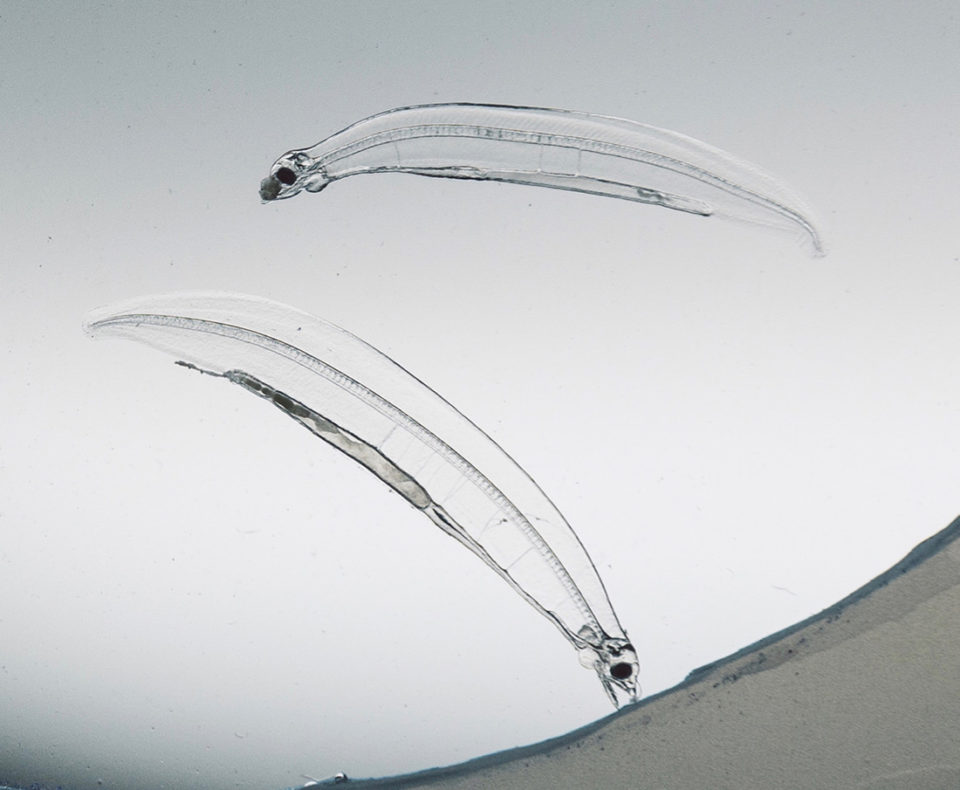
ウナギの赤ちゃんは、透明で葉っぱのような形をしています。
これをレプトセファルス幼生といいます。
5cm位になると形を変えて(これを「変態」といいます)、皆さんおなじみの姿に成長していきます。

卵から生まれ落ちて成魚まで、(国研)水産研究・教育機構の協力を得て、その変遷を追う動画を作ってみました。
「ウナギの成長」、御覧ください。
天然ウナギの産卵風景が確認された例は恐らくありません。

人工飼育下ではありますが、この動画では、雌ウナギが産卵し、その際に放出されたフェロモンを追って雄ウナギが生殖孔に鼻先をつけるようにして追尾しているようにみえます。

魚類一般によく見られる行動ですが、こうしてみると、ウナギもやっぱり魚なのだと感じます。

#ウナギ

Sunday, June 14, 2020

2020年 台日中韓的鰻苗總捕撈量: 83,020公斤

2020年6月6日至6月12日(星期五)鰻苗新聞
節錄自<日本養殖新聞>
(最終追加)
東亞四國中持續進口黑仔的國家有韓國及台灣。而台灣已經明確的表示這些都已經包含在入池的8.5噸中,所以實際變化不大。

韓國方面,根據簡易的數量,上周鰻苗數增加205公斤,累加為6,917公斤。黑子為48.8公斤(換算鰻苗(5000p/kg)約9.76kg),合計為1,222.3kg。

日本國產苗5,375kg,進口苗6,917kg,加上進口黑仔127kg(換算鰻苗),合計12,419公斤。
2020年6月11日止

>>台日中韓的入池量:台灣8,500公斤(10.2%);日本20,100公斤(24.2 %);中國42,000公斤(50.6 %);韓國12,420公斤(15.0%)。總入池量83,020公斤。

>>台日中韓的捕撈量: 台灣7,000公斤(8.4%);日本20,645公斤(24.9 %);中國50,000公斤(60.2 %);韓國5,375公斤(6.5%)。總捕撈量83,020公斤。

Wednesday, June 03, 2020

Reinventing the eel: Can the Anguilla loop be closed?

Reinventing the eel: Can the Anguilla loop be closed?

Bonnie Waycott

The challenge to produce anguillid glass eels for large-scale aquaculture endures in Japan

eel
Because these eel leptocephali (larvae) cannot be reared on feed such as rotifers, zooplankton or pellet diets, development of a special diet was necessary. Photos courtesy of Kindai University.
The Japanese eel (Anguilla japonica) has been a key food in Japan since the Edo era (1603 to 1868) and is commonly consumed as a luxury and seasonal celebration. Kabayaki, or grilled eel with soy sauce and a sugar-based sauce, is a genuine classic with a special place in the Japanese culinary consciousness.
Most of the eel that Japanese consume come from fish farms, yet none are hatched from eggs. Instead, they’re harvested from rivers and coastal waters, often from other continents, as transparent fingerling size glass eels and reared until harvest.
In 2014, the Japanese eel was added to the International Union for Conservation of Nature’s Red List of Threatened Species. This status, and the dependency of fish farms on wild stocks, has a lot to do with the eel’s unique life cycle. Hatched far out at sea, glass eels migrate to freshwater where they mature 5 to 10 years later before travelling to the open ocean to spawn and die.
Scientists have been trying to replicate spawning conditions for eels in captivity for a long time. Beginning in the 1960s, studies were conducted to “close the loop” with breeding, hatching and nursing techniques used in aquaculture. Hormone treatments were used to obtain fertilized eggs and larvae (called leptocephali). Because leptocephali cannot be reared on feed such as rotifers, zooplankton or pellet diets, a paste-type diet made from powdered shark eggs supplemented with krill, soybean peptide, vitamins and minerals was developed and used successfully. Further refining of the diets and rearing procedures resulted in fewer problems such as larval deformities or low survival, and the production of full-size larvae that metamorphosed into glass eels.
eel
National Research Institute of Aquaculture, Japan Fisheries Research and Education Agency.
In 2010 scientists at the National Research Institute of Aquaculture, Fisheries Research Agency (known today as National Research Institute of Aquaculture, Japan Fisheries Research and Education Agency) produced two generations of eels in captivity for the first time. This raised the possibility of an aquaculture industry that neither depends on nor harms wild stocks.
But the mass production of Japanese eel for aquaculture is still elusive.
“Full-cycle aquaculture on a commercial scale has yet to be achieved,” Hideki Tanaka, former group head at the Japan Fisheries Research and Education Agency and now a Kindai University professor, told the Advocate. “Kindai’s research into the artificial production of fry has only just begun. Since 2019, we’ve been working towards full-cycle aquaculture but have only succeeded in egg collection, hatching and the early rearing stage of larvae. Broodstock maturation, egg collection, physical properties of larvae feed, feed ingredients, palatability and the rearing of large numbers of fry all remain difficult. There are still big hurdles to overcome.”
According to Dr. Michael J. Miller of the Department of Aquatic Bioscience at the University of Tokyo, the challenges today appear to be related to how large numbers of larvae can be fed the paste-like diet, which is squeezed onto the bottom of the rearing tanks. When a light above is turned on, the larvae swim downwards and encounter their food. But many die without any intake, suggesting that not all larvae encounter the diet and/or have sufficient swimming ability to reach the bottom. The diet may also be difficult for some larvae to bite or swallow, probably due to poorer ingesting abilities. The paste must also be removed from each tank after every feeding time.
“Keeping the leptocephali alive requires careful attention, but maybe that’s not the problem now,” said Miller. “The effort to scale up production is the challenge. The state of the current effort in Japan is that it’s possible to spawn the eels, grow the leptocephali and produce glass eels. But the food and feeding of these unique leptocephali is the problem for mass production.”
This challenge stems from the unique feeding biology of leptocephali in the ocean, said Miller. Unlike normal fish larvae that typically feed on zooplankton, leptocephali appear to feed on marine snow, tiny detrital particles that are difficult to reproduce for aquaculture. The paste-like diet is also not a natural food for the eels but the shark egg yolk makes it attractive and eels will eat it to survive, possibly due to a chemical compound that stimulates a feeding response.
It’s also worth noting how strange leptocephali are, Miller added. Their organs are reduced in size, making them almost completely transparent with low respiration rates and a unique physiology and growth strategy. Little is known about their life history.
eel
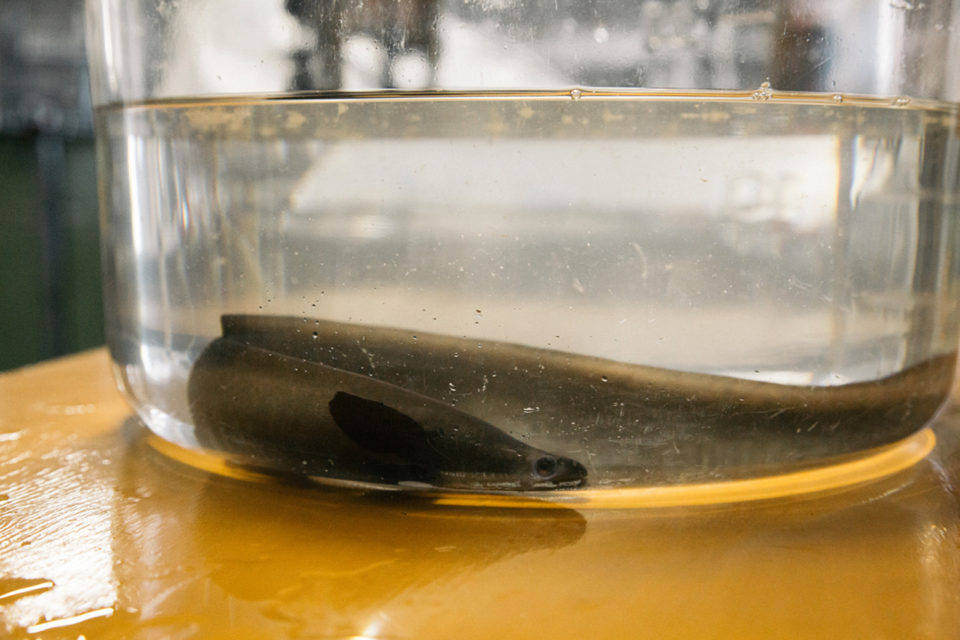
A male eel used in a breeding program at Kindai University. Courtesy photo.
“This unique biology is the only reason why the problem of rearing glass eels wasn’t solved decades ago,” said Miller. “How to deliver the diet seems to be the remaining challenge for producing glass eels in large numbers. It will be interesting to see if the several teams of scientists working on this will succeed in the near future.”
One possible solution is a liquid-type diet. Although its effectiveness for long-term rearing isn’t clear, its volume is greater due to the addition of moisture and it forms a “food pool” on the bottom of tanks, enabling more larvae to encounter it. Larvae may also be able to enter freely and swim in the diet, swallowing it directly.
Several public and private research laboratories in Japan are working to overcome the challenges of producing Japanese eels cost-effectively. However, it’s hard to predict the impact of a shift from fished to farmed glass eels. It may address declining wild stocks but bigger issues could be at play. Freshwater growth habitat reductions or changes to these habitats may be resulting in fewer spawning eels, or changes in the ocean could be affecting larval survival.
Whether farmed glass eels can be produced on a commercial scale is also questionable, says Dr. Ryusuke Sudo, a researcher at Japan’s Fisheries Research and Education Agency.
“We can produce thousands of glass eels each year but nowhere near commercial scale,” he said. “Having said that, I believe we will develop the technology for stable mass production.”
“Full cycle eel aquaculture is very important,” he continued. “If commercial scale production becomes possible, so too will protecting wild stocks and stabilizing the supply of seedlings. But we’ll need to develop a new larval diet and improve rearing systems.”
Small-scale production is possible, said Tanaka. “But it won’t be easy to achieve, especially in a way that costs less than the procurement of wild seed,” he said. “It’s impossible to grasp the impact of farmed glass eels but full cycle aquaculture could be a sustainable form of Japanese eel production that doesn’t depend on the wild. By reproducing successive generations, we expect good things like high growth rates and strong disease resistance. That’s something to look forward to.”
Follow the Advocate on Twitter @GAA_Advocate

Wednesday, May 27, 2020

L'anguille et le chat


Restocking boost for European eel population

Restocking boost for European eel population 
 May 27, 2020 

Some 376,000 young eels have been released into the Grevelingenmeer lake in an effort to replenish European stocks, local broadcaster Omroep Zeeland reports. 

The action, which is part of a European-wide effort to stimulate the eel population, is being coordinated by the Dutch association for sustainable eel trade Dupan, which unites eel traders, fish farmers and professional fishermen.

The eels were caught in river estuaries in France as they made their way back from their spawning ground in the Sargossa Sea in the western Atlantic where eels from across the world congregate. They were then kept at a nursery at a fish farm to gain strength. 

The eel has been making a European comeback in the last ten years. Eels cannot be farmed in numbers as they only procreate in the wild but blockades on their migration routes, pollution (which is also stored in the animal’s fatty tissue) and parasites had decimated their number. 

The eel, which were counted, weighed and checked for health problems, were distributed across the Grevelingenmeer by young fishermen, Omroep Zeeland said. In March a million eels were released into the Veerse Meer and last week, a further 200,000 were set free in Friesland. 

Smoked eel is considered a delicacy in the Netherlands but most of it is not wild but fattened up young eel from fish farms.

Read more at DutchNews.nl:
 (https://www.dutchnews.nl/news/2020/05/restocking-boost-for-european-eel-population/)

Eel smokehouse

Dutch Culture
The eel smokehouse has almost disappeared from Monnickendam, but in the past the town was full of eel smokehouses.

Smoking and trading fish was an important professional branch in Monnickendam. This did not apply to catching the fish, mainly the inhabitants of Volendam, Marken and Durgerdam did.

With the arrival of the Afsluitdijk, the fishing industry was hit hard and almost all smokehouses disappeared from the city, except two.
The arrival of the Afsluitdijk in 1932 brought about a major change in the fish stock. Within a few years, the salty sea had become a fresh water lake. The sea fish, including the Zuiderzee herring, disappeared. Fortunately the eel remained.
This fish lives in freshwater, but spawns in the salty waters of the Atlantic. The few months old and transparent glass eels retreat from the ocean to the fresh water. After a stay of between 5 and 15 years in the fresh water, the eels swim to the spawning grounds where they come from. The amount of glass eel has decreased enormously in recent decades worldwide, as a result of which fewer eels swim in the IJsselmeer. A number of strict measures have been announced to save the eel from extinction. One of the measures is a total fishing ban in the period September-November. Every year it is determined whether such a ban is necessary in the IJsselmeer.
Top right: Arie Kaars, a striking figure in Monnickendam. hobby eel smoker and movie star. And one of about 125 participants in the annual eel smoking competition.

Thursday, May 21, 2020

Where Do Eels Come From?

Where Do Eels Come From?

There is much to be learned from how little we know about them.

https://www.newyorker.com/magazine/2020/05/25/where-do-eels-come-from)
The mysterious creature has attracted avid detectives since ancient times.Illustration by Jason Holley
In the spring of 1876, a young man of nineteen arrived in the seaside city of Trieste and set about a curious task. Every morning, as the fishermen brought in their catch, he went to meet them at the port, where he bought eels by the dozens and then the hundreds. He carried them home, to a dissection table in a corner of his room, and—from eight until noon, when he broke for lunch, and then again from one until six, when he quit for the day and went to ogle the women of Trieste on the street—he diligently slashed away, in search of gonads.
“My hands are stained by the white and red blood of the sea creatures,” he wrote to a friend. “All I see when I close my eyes is the shimmering dead tissue, which haunts my dreams, and all I can think about are the big questions, the ones that go hand in hand with testicles and ovaries—the universal, pivotal questions.”
The young man, whose name was Sigmund Freud, eventually followed his evolving questions in other directions. But in Trieste, elbow-deep in slime, he hoped to be the first person to find what men of science had been seeking for thousands of years: the testicles of an eel. To see them would be to begin to solve a profound mystery, one that had stumped Aristotle and countless successors throughout the history of natural science: Where do eels come from?
The nineteenth century had brought Darwin and Mendel, Pasteur and Mendeleev, and a growing sense that scientists (a word coined only in the eighteen-thirties), with their studies and their systems and their microscopes, were at last equal to solving the great quandaries of the natural world. Questions that had befuddled mankind for centuries—where life comes from, what it is made of, how it changes, why it ends—were now seen as knowable, quantifiable, explicable. Just two years before Freud arrived in Trieste, the German biologist Max Schultze, lying on his deathbed, observed, perhaps wistfully, that he was leaving a world where “all the important questions . . . had now been settled.” All of them, that is, “except the eel question.”
What could be more ordinary than an eel? Not so long ago, European eels, Anguilla anguilla, were widely eaten. In Sweden, they might be smoked, braised in beer, or fried in butter; in Italy, boiled in tomato sauce; in England, jellied in stock, or fried with eggs into an elver cake. They were a simple and abundant food enjoyed by members of the poorer classes, like the Cockney woman described in “King Lear” who accidentally puts them in a pie still alive.
People caught eels in brooks, rivers, lakes, the sea. They also caught them, inexplicably, in ponds that dried out and refilled each year, and that had no access to other bodies of water. They couldn’t help but notice that the creatures seemed to have no ovaries, no testicles, no eggs, no milt. That they were never observed to mate. That they sometimes seemed to issue from the earth itself. Eels were unaccountable, and so, writes the Swedish journalist Patrik Svensson in “The Book of Eels” (Ecco), an unusual and beguiling guide to an unusual and beguiling animal, it fell to us to try our best to account for them.
The ancient Egyptians believed that eels were produced by the sun warming the Nile; Aristotle decided that eels emerged spontaneously from mud and rainwater. Pliny the Elder thought that new eels developed when old eels rubbed away parts of their bodies on rocks. As late as the eighteen-sixties, a Scottish author espoused an old belief that they began their lives as beetles. “Some believed eels were born of sea-foam,” Svensson writes, “or created when the rays of the sun fell on a certain kind of dew that covered lakeshores and riverbanks in the spring. In the English countryside, where eel fishing was popular, most people adhered to the theory that eels were born when hairs from horses’ tails fell into the water.”
The truth emerged only slowly, and was, in its own slippery way, stranger than the fiction. Careful observers discovered that what had long been taken for several different kinds of animals were in fact just one. The eel was a creature of metamorphosis, transforming itself over the course of its life into four distinct beings: a tiny gossamer larva with huge eyes, floating toward Europe in the open sea; a shimmering glass eel, known as an elver, a few inches in length with visible insides, making its way along coasts and up rivers; a yellow-brown eel, the kind you might catch in ponds, which can move across dry land, hibernate in mud until you’ve forgotten it was ever there, and live quietly for half a century in a single place; and, finally, the silver eel, a long, powerful muscle that ripples its way back to sea. When this last metamorphosis happens, the eel’s stomach dissolves—it will travel thousands of miles on its fat reserves alone—and its reproductive organs develop for the first time. In the eels of Europe, no one could find those organs because they did not yet exist.
But, even as these answers were arrived at, “the eel question,” as it was widely known, proved to be as changeable as the eel. It seemed to be forever unsolvable, for behind any eel answer there was always another eel question, shrouded by more layers of mystery.
“We know, then, that the old eels vanish from our ken into the sea, and that the sea sends us in return innumerable hosts of elvers,” a Danish searcher, Johannes Schmidt, wrote. “But whither have they wandered, these old eels, and whence have the elvers come?” Schmidt became consumed by his questions; in 1904, he left his family in Copenhagen and set out to scour the seas for the very smallest of eels. For seven years, he trawled the coasts of Europe, but found only larger larvae. For another three years, he enlisted shipping companies to net larvae as they plied the North Atlantic, and turned his own schooner west and south. Net by net, he mapped the ocean according to which parts of it contained eel larvae, and how large those larvae were, until the tiniest ones led him to their point of origin. It was a slow process, made slower by a shipwreck and a world war. Finally, nineteen years after he first set out, Schmidt announced his findings. “How long the journey lasts we cannot say,” he wrote, summoning the grandeur warranted by the occasion. “But we know now the destination sought: a certain area situated in the western Atlantic, N.E. and N. of the West Indies. Here lie the breeding grounds of the eel.”
Schmidt had traced the Anguilla anguilla to the Sargasso Sea—a sea within a sea, a garden of seaweed bounded not by land but by great currents of water. (The American eel breeds there as well, and it is still something of a mystery how the larvae, all mixed together but genetically distinct, know which continent is their future home. The Japanese eel has its own breeding grounds, in the Pacific, and another famous freshwater eel, the electric one of South America, is not actually an eel at all; it’s a knifefish.) Schmidt’s discovery was an answer, and, in the past century, no one has successfully challenged it; that European eels come from the Sargasso Sea remains the official word of science. But, as with that sea and the animal born there, the boundaries of this knowledge are fluid and strange. Many expeditions have followed Schmidt to the breeding grounds in the decades since, each with better technology than the last. They, too, have found plenty of larvae, but, when one expedition collected and examined seven thousand fish eggs, not one of them turned out to be from an eel. Scientists have put G.P.S. trackers on silver eels beginning their migration; they’ve used hormones to bring females into heat, transported them to the breeding grounds, and attached them to buoys to use their pheromones as bait. They have dropped microphones into the water and opened the stomachs of predators. And yet no one has ever seen Anguilla anguilla mating anywhere, or so much as set eyes on a mature eel, living or dead, in the Sargasso Sea.
VIDEO FROM THE NEW YORKER
Dogs Are People, Too
When Svensson was a child, in Sweden, he spent many evenings with his father, a road paver, on the banks of a stream that ran past his father’s childhood home. Together, as dusk fell, they would rig and bait their lines and throw them into the stream, then drive home to the swooping of bats. At sunrise, they checked to see which hooks had been taken by yellow-brown eels, which they collected in buckets and ate fried or boiled. (His father relished the taste, but Svensson found it nauseating; it was the fishing, and the time with his father, that he loved.) He describes his father as a thoughtful man, “fascinated by all the strange and wonderful forms life took,” but most of all by the peculiarity of eels: “ ‘They’re odd, eels,’ Dad would say. And he always seemed mildly delighted when he said it. As though he needed the mystery. As though it filled some kind of emptiness in him.”
Once, the pair tried an old Swedish fishing method that involved stringing lots of worms on a thread and then rolling them “into a quivering, stinking ball of slime and secretions and writhing bodies.” To catch the necessary worms, Svensson’s father attached electric cables to the prongs of a pitchfork sunk into a freshly watered lawn, creating a surge of electricity that brought a wave of panicked worms wriggling to the surface. With the worm ball, they caught eel after eel, more than they’d ever caught before, “like pulling carrots out of a vegetable patch.” But they didn’t do it again. There was no struggle in it, no mystery or chance or solemnity. “It didn’t tally with what we wanted the eel to be,” Svensson muses. “Maybe we had gotten too close to it.”
Svensson’s book, like its subject, is a strange beast: a creature of metamorphosis, a shape-shifter that moves among realms. It is a book of natural history, and a memoir about a son and his father. It is also an exploration of literature and religion and custom, and what it means to live in a world full of questions we can’t always answer. Svensson writes on page 1 that the eel “eludes the usual measures of the world,” and as the book progresses he begins to see other things as similarly elusive. He has seen eels that appear to be dead but are not, and eels that really are dead—chopped up and frying in butter, even—but still move as though they were alive. “To the eel, death seemed relative,” he writes. He has learned that the timing of an eel’s final transformation, the one that brings it to both its own death and the birth of the next generation, seems to be unrelated to time itself: eels might feel the pull to return to the sea after eight years inland, or after nearly sixty, or never, remaining behind in a sort of suspended animation. The eels that travel together across the ocean might be at the same stage of life, yet decades apart in age. Svensson is captivated by the implications of this. “You have to ask yourself: How does a creature like that perceive time?” he wonders.
Svensson’s grandmother was a believer in both God and gnomes. His father was not a believer, and neither is Svensson; their skepticism faltered “only where the eel was concerned.” When his grandmother was dying, she told Svensson, “I will always be with you,” and he immediately trusted her: “I didn’t need to believe in God to believe that.” Eventually, Svensson’s father became sick with cancer, likely a result of his years paving roads, breathing in the steam of asphalt. In the summers before the diagnosis, Svensson had often visited him. “We drank coffee, and talked about eels we’d caught and eels we’d lost and not much else,” he writes. As his father faded, Svensson lingered over the mysteries of time and existence, the watery border between death and life. He read Rachel Carson, who kept a tank of eels in her office and made an eel named Anguilla a protagonist of her first book, “Under the Sea-Wind.” Anguilla lived in the pleasantly warm mud of a pond, “beyond all reminders of the sea” that another of her selves once knew. Still, one day, she felt the urge to depart her current life, her current self, to transform and make her way through “frigid waters, deliberate and inexorable as time itself,” to a place where no one could follow. “No one can trace the path of the eels,” Carson wrote.
A decade later, and a decade before Carson, too, died of cancer, she published another book about the sea. She describes it as a place where man “feels the loneliness of his earth in space. And then, as never on land, he knows the truth that his world is a water world, a planet dominated by a covering mantle of ocean, in which the continents are but transient intrusions of land above the surface of the all-encompassing sea.”
The International Union for Conservation of Nature, a body charged with assessing the status of the natural world, has, unsurprisingly, had some trouble with eels. Ideally, to determine how the species is doing, the I.U.C.N. would like to know the number of “mature eels at their spawning grounds”—a number that is as knowable as the number of angels who can dance on the head of a pin.
Because ours is a world of making do, the I.U.C.N. instead counts the small glass eels that arrive in Europe each spring. For every hundred eels that showed up on the coasts in the nineteen-seventies, it’s believed that now only five come to wriggle their way inland. The formerly ordinary, everyday eel is classified as critically endangered, the last official designation on the road toward nonexistence. (Well, there is also “extinct in the wild,” but without their wild breeding grounds eels are nothing. No one has ever managed to breed them in captivity.) Svensson writes, “This is the latest and most urgent eel question: Why is it disappearing?”
There are many possible reasons, from disease to dams and locks, from fishing pressure to the warming climate, which is causing the ocean currents by which eels make their migrations to shift and change. But there may be other answers, and scientists are racing to find them—a quest that Svensson obviously supports but nonetheless considers not a little tragic. “Those of us who want to protect the eel in order to preserve something genuinely mysterious and enigmatic in a world of enlightenment will, in some ways, lose no matter how things turn out,” he writes. “Anyone who feels an eel should be allowed to remain an eel can no longer afford the luxury of also letting it remain a mystery.”
In our age of extinctions, every loss is like this: the disappearance not just of a creature from its ecosystem but of all that we might learn about it, all that we invest in it, all its layers of meaning, from our human future. To lose the eel is one grief; to lose the eel question, another. ♦